They Know Where the Killers Live...
They Just Won’t Stop Them.

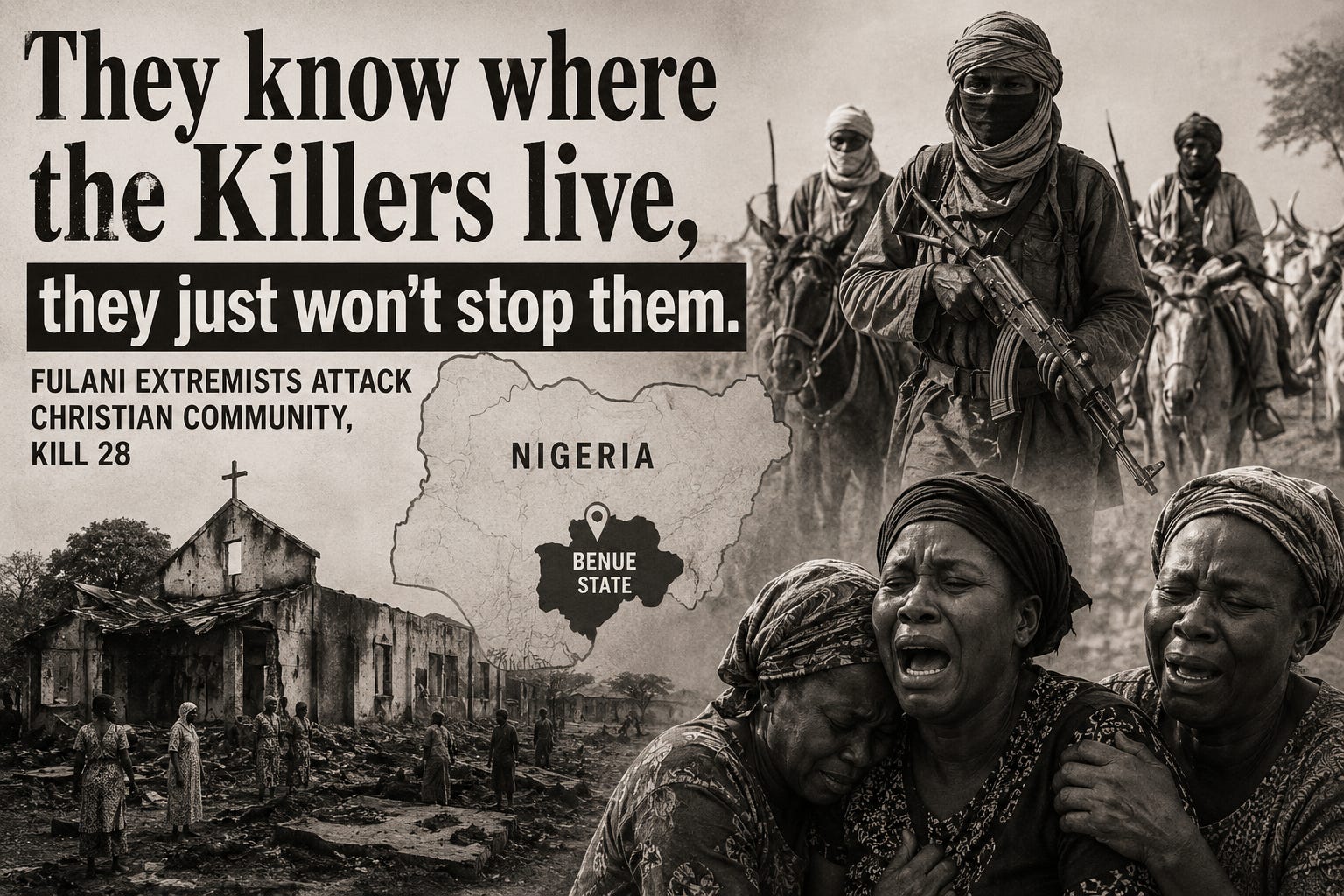
At midnight on June 21, a Christian farming village called Kawell, in the Mushere District of Plateau State, came under attack. The assault lasted three hours. When it was over, twenty-two people were dead, including the village reverend and a healthcare worker killed on duty at the clinic. Four of the dead were children. The oldest was six. The youngest was four.
Here is the detail I cannot get past. A Nigerian Army formation was stationed less than one kilometer away. They received distress calls. They did not move. The soldiers arrived two to three hours after the attackers had already finished and left.
A mile away. Three hours of killing. And the men with rifles and a mandate to protect those people stayed where they were.
That is the whole story of Nigeria’s security failure compressed into a single night. And it happened on the first anniversary of the Yelwata massacre, where a year ago Fulani militants went house to house for three hours and killed more than two hundred and fifty people. The anniversary was marked with a memorial Mass and a cenotaph engraved with the victims’ names. It was also marked, apparently, with another massacre — because the people who do this know the calendar, and they know that nothing they did last year cost them anything.
A pattern, not a panic
For years the official story out of Abuja, and for too long the story repeated by Western diplomats and reporters who should have known better, was that what’s happening in Nigeria is essentially spontaneous. Herders and farmers fighting over land and water. Climate change pushing pastoralists south. Criminal gangs after ransom. A tragedy, yes, but not a campaign. Certainly nothing with theology in it.
I’ve sat with enough survivors to tell you that’s a comfortable fiction, and the comfort runs in one direction. It comforts the government that has failed to protect its own citizens. It does nothing for the people in the ground.
A few years ago a man who had lived through one of these raids told me something I’ve never been able to shake. Before the attackers came, he said, the phones went dead. No signal. No way to warn the next village. No way to call anyone who might have come. I filed it away as one more cruel detail. Then I kept hearing it. From other survivors, other villages, attacks separated by hundreds of miles and months of time. The cell service goes first. Then the killers arrive. Then, hours later, the soldiers show up to count the dead.
That is not how a riot works. That is how an operation works.
Look at what survivors and local reporters actually describe, and a method emerges. Attackers arrive at night, heavily armed, often on motorcycles, advancing on a sleeping village from several directions at once. The Yelwata survivors described exactly this — a coordinated assault hitting the community from both the eastern and western flanks simultaneously. They come in numbers no spontaneous mob assembles, and they move with what residents repeatedly call “familiarity” across local and even state boundaries. In Benue this spring, witnesses watched raiders cross the Benue–Taraba border on motorcycles and river crossings, the same routes used in earlier raids, striking and vanishing before any security force arrived. The same week, in a separate incident, a small unit set up a roadblock at a highway junction and shot a man as he traveled by motorcycle. Premeditated, residents said. Not a clash. An ambush.
These are not improvisations. Cutting communications, blockading roads, coordinating simultaneous strikes from multiple flanks, running diversionary raids to pull thin security forces toward one village while the real target is hit somewhere else — these are tactics. Studied ones. Researchers documented years ago how insurgents in Nigeria’s northeast perfected this kind of simultaneity, using dummy raids to draw security forces one way while the main force struck the objective. The methods have migrated. The groups have blended. And the sophistication is rising, not falling — fighters reportedly running tactical drills along border corridors, acquiring better weapons, in some cases targeting communications infrastructure directly.
Say the quiet part
Here is what I’ve learned from saying things people in my old world preferred I not say: you can acknowledge complexity and still tell the truth about intent.
Yes, the Middle Belt has real land pressure. Yes, desertification is real. Yes, the great majority of Fulani are ordinary people with no part in any of this, and the Sultan of Sokoto is right to say so. All of that can be true at once. None of it explains why attackers shout “Allahu Akbar” and that they will destroy all Christians as they burn a village. None of it explains the survivor in Benue who described his attackers speaking Fulfulde and chanting as they surrounded a prayer meeting. None of it explains the church massacres, the targeting of Christian farming settlements, the roadblock killings that establish who you are before deciding your fate. Boko Haram and ISWAP have stated their purpose plainly and repeatedly: an Islamic state where their reading of Islam is the only one permitted, and everyone else — Christian, or the wrong kind of Muslim — is an infidel to be driven out or killed.
When a group tells you what it intends, and then does precisely that, year after year, calling it a resource dispute is not analysis. It is evasion.
The duty they’re walking away from
I keep returning to that army formation a mile from Kawell, because it is the fact that turns tragedy into culpability.
Everyone knows where these groups operate. The warlords are named. Their corridors are mapped. Their training grounds are reported in the press. Intelligence officials issue warnings before attacks — last Christmas, the government’s own National Security Adviser quietly called for heightened vigilance even as the Presidency publicly downplayed the threat. Villagers call ahead, when the phones still work, to say the killers are coming. The information is not the problem. The information has been sitting there for years.
A government’s first obligation, its most basic one, is the duty of care it owes every citizen. Nigeria’s own constitution guarantees the right to life. When the state knows where armed groups are massing, knows the routes they take, receives the distress calls — and still its soldiers sit a kilometer away for three hours while a village is destroyed, then arrive to round up suspects who are quietly released, never charged, never tried — that is not the helplessness of a poor country doing its best. That is a choice. And a state that consistently chooses not to protect one set of its citizens, while minimizing and re-labeling the very nature of the threat against them, makes itself complicit in the outcome.
I want to be precise, because precision matters. I am not claiming officials in Abuja sit in a room directing these raids. I am claiming something harder to dodge: that a government with the knowledge to interdict these attacks, the duty to try, and the pattern in plain sight in front of it — and which instead spends its energy parsing language, disputing the religious dimension, and treating dead villagers as a public-relations problem — has failed the most elementary test of governing. Willful blindness, when you hold the duty of care, is not innocence.
Why the words finally changed
For a long time the West largely accepted Abuja’s framing: criminal gangs, herder-farmer friction, nothing systematic, nothing religious. That has started to crack. The United States has re-designated Nigeria a Country of Particular Concern. Members of Congress have held briefings and said plainly that this is not “inter-communal violence” or a “resource conflict” but a targeted campaign to drive Christians off their ancestral land. Even Benue’s own governor now says his state is under siege by terrorists, “way beyond farmer-herder crisis.”
Some will dismiss all of this as politics. Let them. The shift in language matters because for two decades the wrong words protected the wrong people. Calling a coordinated assault a “clash” disarms the moral urgency to stop it. Naming it accurately is the precondition for doing anything about it.
I’ve spent my career arguing that institutions optimize for how things look rather than what actually happens to people. Nigeria’s security failure is that pathology at national scale, with a body count. The optics say “complex regional dynamics.” The outcome is a soldier standing a mile from a screaming village, waiting for the noise to stop.
What I’m asking
I’m not asking anyone to flatten this into a slogan. The situation is real, and reality has texture. I’m asking for the opposite of a slogan: sustained, honest attention to a pattern the people living inside it have described accurately for years, while the people responsible for protecting them looked the other way.
The phones go dead. The killers come. The soldiers wait. And in the morning a spokesman explains that it was probably just a dispute over grazing land.
The survivors of Kawell know better. So do the families burying four children none older than six. It is long past time the rest of us said so out loud — and held the people with the duty of care accountable for the lives they keep choosing not to protect.